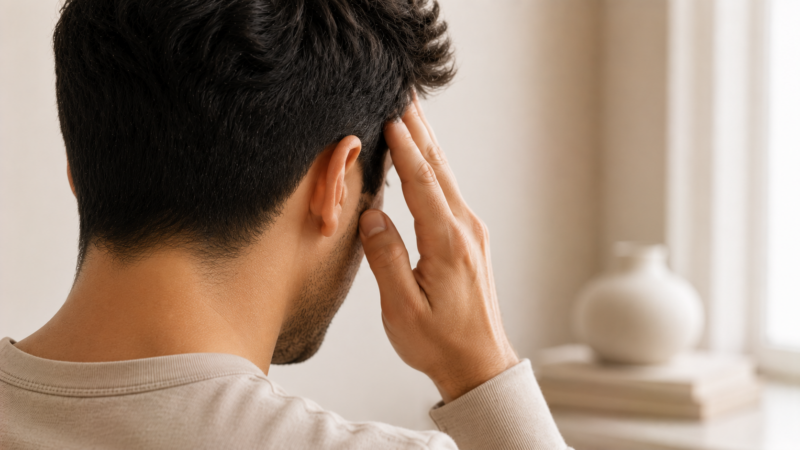

Many patients with severe head and neck pain move between neurologists, chiropractors, physical therapy, medications, and injections without lasting relief. They may be told they have migraines, tension headaches, or neck pain, but the connection between the head and cervical spine is often missed.
The source matters because migraine and cervicogenic headache are not treated the same way. One begins primarily as a neurologic process. The other is driven by a structural or mechanical problem in the neck.
In many patients, both are involved.
The Shared Head and Neck Pathway
The head and neck share important pain-processing pathways. One key region is the trigeminal nucleus caudalis, which helps process sensation from the face, head, occipital region, and upper cervical spine.
This shared wiring means irritation in the cervical joints, discs, muscles, or nerves can be experienced as head pain. A problem in the neck can feel like a headache, and a headache disorder can make the neck tighten and guard.
What Migraine Can Feel Like
Migraine is a neurologic condition involving an overactive and sensitized brain network. It may cause throbbing head pain, nausea, light sensitivity, sound sensitivity, visual symptoms, dizziness, brain fog, or mood changes.
Some migraines do not present with obvious head pain. In certain patients, migraine may feel mostly like severe neck pain, pressure, nausea, or sensory sensitivity.
This is one reason migraine can be difficult to distinguish from a neck-driven headache.
What Cervicogenic Headache Can Feel Like
A cervicogenic headache begins in the neck. It may come from irritated cervical facet joints, upper cervical instability, disc irritation, muscle guarding, or occipital nerve irritation.
This pain is often mechanical. It may worsen with posture, turning the head, coughing, looking down, or moving from lying down to standing. It may feel sharp, stabbing, one-sided, or like pain that starts at the base of the skull and travels upward.
In patients with hypermobility or Ehlers-Danlos syndrome, craniocervical instability can add another layer by stressing the head-neck junction and surrounding nerves.
In a patient with both, the cervicogenic headache will often trigger a migraine.
What a Proper Workup Requires
A proper workup should not assume all head pain is migraine or all neck pain is muscular.
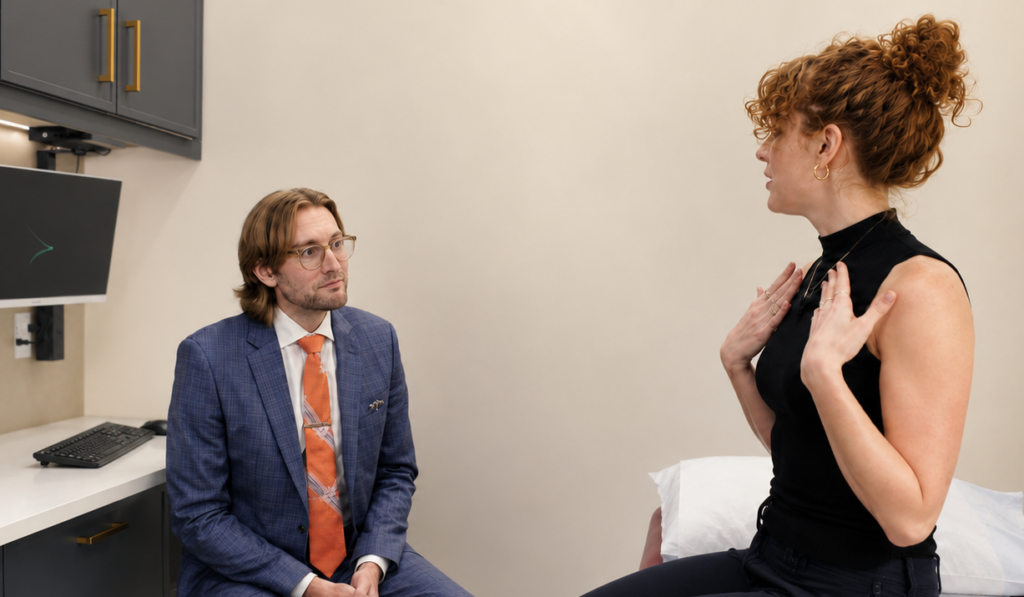
It should ask whether the primary driver is neurologic, structural, or both. That may include evaluating migraine patterns, cervical joints, occipital nerves, posture, instability, imaging, physical exam findings, and response to targeted diagnostic blocks.
Our Approach at MPM
At Manhattan Pain Medicine, we evaluate migraine and cervicogenic headache together, helping patients identify whether symptoms are coming from migraine biology, cervical joints, occipital nerves, craniocervical instability, muscle guarding, or a layered head-neck pain pattern.