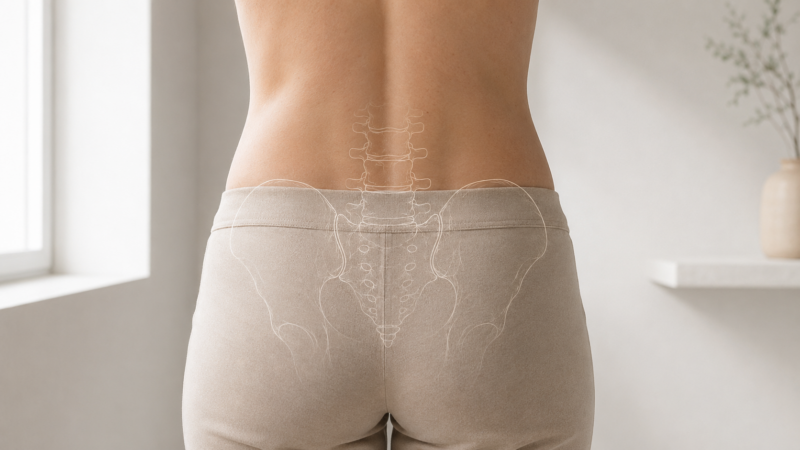

Many patients with sacroiliac joint dysfunction spend years being treated for other problems. They may be told they have a herniated disc, piriformis syndrome, hip pain, pelvic floor dysfunction, or sciatica.
The sacroiliac joint, or SI joint, connects the sacrum at the base of the spine to the pelvis. It is designed to be stable, with only a small amount of movement. When the ligaments around the joint become loose, strained, or unstable, the joint may begin to shift, shear, or move more than it should.
That instability can create pain in the low back, buttock, groin, hip, pelvis, or leg, which is why SI joint dysfunction can be difficult to recognize.
Why SI Joint Pain Mimics Other Conditions
SI joint dysfunction can look like several different diagnoses.
It may refer pain down the back of the leg and feel similar to sciatica. It may cause deep buttock pain that gets labeled as piriformis syndrome. It may contribute to pelvic pain or sitting intolerance when the surrounding ligaments and pelvic nerves become irritated.
A standard MRI may not show the problem clearly. Mechanical SI joint instability often appears during sitting, standing, walking, or position changes, not while the patient is lying still in a scanner.
The Hip and Pelvis Connection
The SI joint does not work alone. It is part of a larger lumbopelvic system that includes the lumbar spine, hips, pelvis, pelvic floor, and deep stabilizing muscles.
If the hip is unstable, hypermobile, or impinged, the pelvis may compensate. If the SI joint is unstable, the surrounding muscles may tighten to protect it. This guarding can create secondary muscle pain, nerve irritation, and pelvic floor tension.
In some patients, SI joint instability can also contribute to irritation near the pudendal nerve, creating genital, rectal, perineal, or sitting-related pain.
What a Proper Workup Requires
A proper SI joint workup should not rely on imaging alone. It should include a careful history, hands-on exam, movement testing, hip and spine assessment, and evaluation of how the pain changes with sitting, standing, walking, and transitions.
Targeted diagnostic injections may help clarify whether the SI joint is contributing to the pain. If the joint is unstable, treatment may need to focus on restoring structural support rather than only reducing inflammation.
For some patients, regenerative treatments such as prolotherapy or PRP may be considered to address ligament laxity. Physical therapy may then help restore safer movement patterns and reduce compensatory guarding.
Our Approach at MPM
At Manhattan Pain Medicine, we evaluate SI joint pain as part of the full lumbopelvic system, helping patients identify whether symptoms are coming from joint instability, hip mechanics, nerve irritation, pelvic floor guarding, or a layered pain pattern.