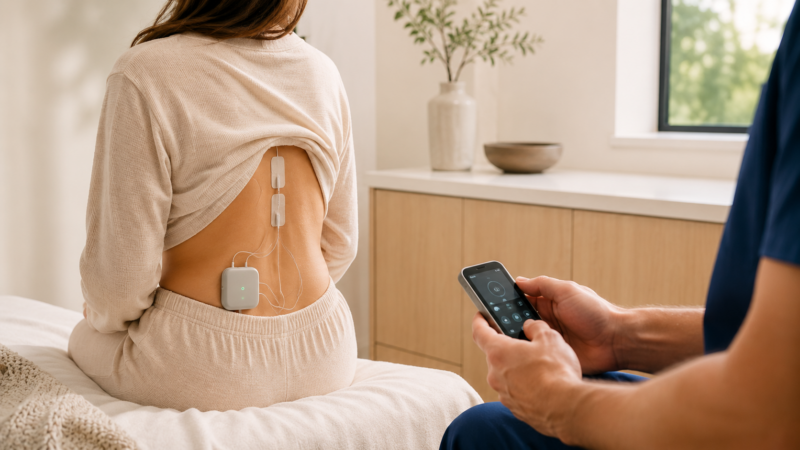

When patients hear about spinal cord stimulation or dorsal root ganglion stimulation, they often have one of two reactions. Some are frightened by the idea of implanted hardware. Others have been led to believe that a device will be a cure-all.
The reality is more careful. Neuromodulation can be a powerful tool for chronic, difficult-to-treat pain, but it is not the right answer for every patient or every pain generator.
What Spinal Cord Stimulation Does
Spinal cord stimulation uses electrical signals to change how pain messages travel through the nervous system. Instead of fixing a structure directly, it helps modulate how pain is processed between the spine and the brain.
This can be especially helpful when the nervous system has become highly sensitized or when pain signals continue even after other treatments have failed.
It is important to understand the limitation: a stimulator does not repair a torn ligament, stabilize a loose joint, reverse active inflammation, or fix a mechanical pain generator. It may reduce the alarm signal, but it does not necessarily treat the source of the alarm.
What It Can Help With
One major advantage is the trial period. Before a permanent implant, patients complete a temporary trial. Leads are placed under image guidance and connected to an external device. The patient then tests the stimulation in real life before deciding whether to move forward.
Spinal cord stimulation and DRG stimulation may be considered for severe nerve pain, central sensitization, Complex Regional Pain Syndrome, persistent spine-related pain, and certain complex pelvic pain patterns.
In some patients, reducing the pain signal over time may help the nervous system calm down and relearn a less reactive pattern.
What It Cannot Do
Neuromodulation is not simple, and programming can require significant trial and error. Sometimes one pain area improves while another becomes more noticeable. Sometimes the relief fades if the nervous system adapts around the stimulation.
There are also hardware realities. Leads can move. Batteries eventually need replacement. Some patients do not tolerate the sensation or the physical presence of the device well.
For these reasons, spinal cord stimulation is not a first-line shortcut.
What a Proper Workup Requires
Before considering an implanted device, the care team should ask: Is there a treatable mechanical, inflammatory, autoimmune, nerve, or joint problem driving the pain?
When possible, the goal is to identify and treat the root cause first. Diagnostic blocks, targeted procedures, rehabilitation, medication management, regenerative options, or temporary peripheral nerve stimulation may be considered before permanent implantation.
Our Approach at MPM
At Manhattan Pain Medicine, we view spinal cord stimulation as one advanced tool within a broader diagnostic plan, helping patients determine whether neuromodulation is truly the right next step for their pain.