
Many patients with lumbar spinal stenosis describe a very specific pattern. They can stand or walk for only a few minutes before burning, cramping, heaviness, or pain travels into the buttocks or legs. Then, after sitting or leaning forward, the symptoms improve.
This pattern is often called neurogenic claudication. It happens when the nerves in the lower spine do not have enough room, especially when the spine is upright and under the force of gravity.
Why Standing and Walking Can Hurt
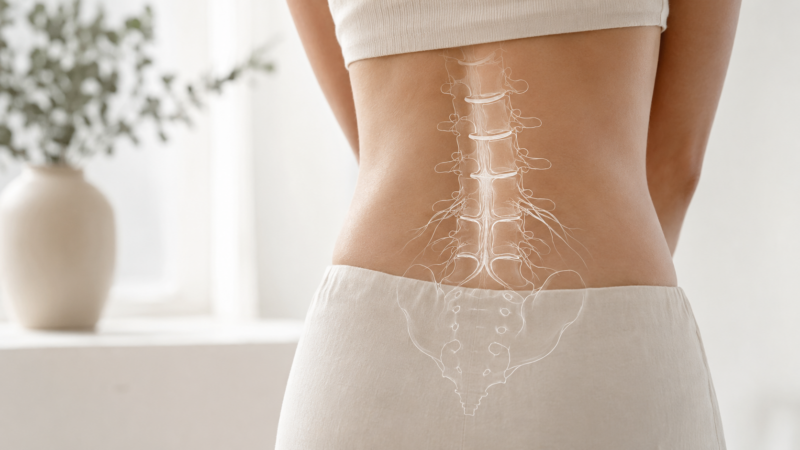
Spinal stenosis means there is narrowing in the spinal canal or in the openings where nerves exit the spine.
The spine is not static. The amount of space around the nerves can change depending on posture, movement, and load. Standing and walking often place the lower back into more extension, which can narrow the canal further and increase pressure around the nerves.
Tight hip flexors may also pull the pelvis forward, creating an anterior pelvic tilt. This can increase the arch in the lower back and add compression through the facet joints, discs, and nerve spaces.
In some patients, the vertebrae may also shift with movement, a pattern called dynamic instability. This may not be fully visible on a standard MRI taken while lying down.
Why Sitting Can Feel Better
Sitting or leaning forward flexes the lumbar spine. This position can temporarily open the spinal canal and give irritated nerves more space.
That is why some patients feel better when sitting, bending forward, or leaning over a shopping cart.
This pattern can help separate stenosis from other spine problems. Disc-related pain may worsen after sitting for a period of time. Sacroiliac joint dysfunction or Bertolotti syndrome may cause sharper, more localized pain with sitting, twisting, or position changes.
What a Proper Workup Requires
A proper workup should connect the symptoms to the mechanics of the spine, hips, pelvis, and nerves.
Standard MRI can be useful, but it may not show how the spine behaves while standing, bending, or walking. Flexion and extension X-rays can help identify whether vertebrae are shifting dynamically.
A hands-on exam is also important. Hip flexor tightness, pelvic tilt, neural tension, muscle guarding, and walking tolerance all provide clues.
Treatment may include targeted epidural injections to reduce nerve inflammation and improve nerve mobility, followed by physical therapy focused on hip mobility, core stability, posture, and safer movement patterns. If symptoms remain severe despite appropriate care, surgical decompression may be considered.
Our Approach at MPM
At Manhattan Pain Medicine, we evaluate spinal stenosis through a diagnosis-first lens, helping patients understand whether leg pain is coming from nerve crowding, dynamic instability, disc irritation, hip mechanics, or a layered spine pattern.