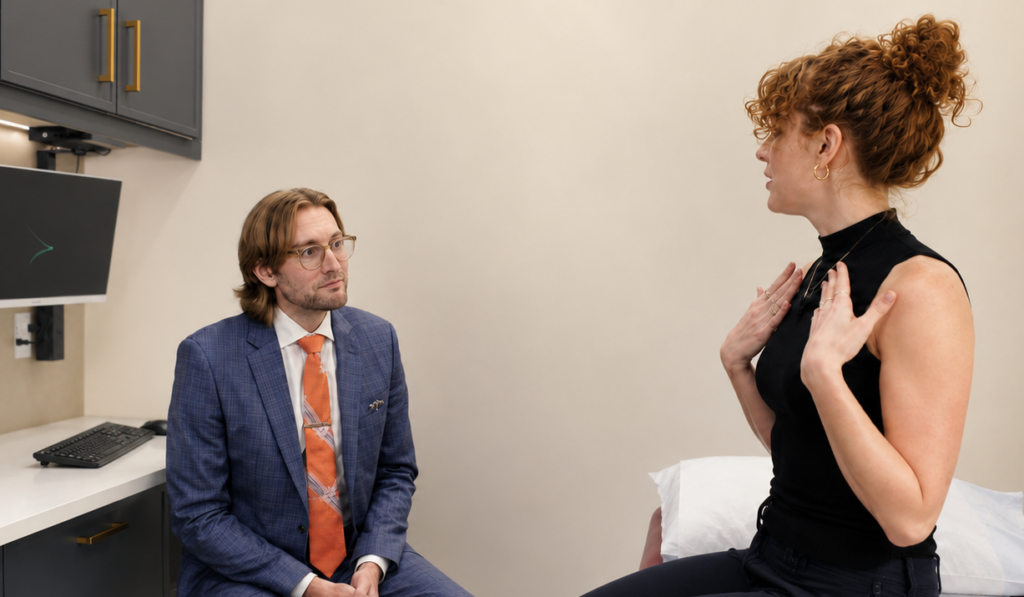

Written in collaboration with Adam Gvili, PT, DPT, board-certified physical therapist and owner of Pelvis NYC.
Male pelvic floor dysfunction is often treated as a local pelvic-floor problem, yet symptoms do not always begin there. In some men with chronic pelvic, testicular, or groin pain, painful urination, rectal pressure, or difficulty sitting, an overactive pelvic floor may be reacting to a problem elsewhere. One overlooked contributor is the hip.
For this article, Dr. Gvili contributes his perspective on movement patterns that may indicate hip-related guarding and how rehabilitation changes when the hip is involved.
This article focuses on overactive or guarding pelvic floor patterns. It does not describe every form of male pelvic floor dysfunction, and pelvic, urinary, or scrotal symptoms require appropriate medical evaluation.
When the Pelvic Floor Is Reacting, Not Causing
The pelvic floor works with the hips, pelvis, lower spine, abdominal wall, and nearby nerves.
When a hip is painful or mechanically compromised by hip impingement, labral pathology, or instability, the nervous system may recruit the deep hip rotators, hip flexors, adductors, and pelvic floor to protect the joint.
The result can be recurrent pelvic-floor tightness or spasm. Releasing the muscles may help temporarily, but symptoms can return if an unresolved hip or pelvic-ring contributor remains active.
This is why a “tight pelvic floor” is not always the complete diagnosis. The key question may be: why is it tight?
The Hip, Pelvic Floor, and Nerves Are Closely Connected
The obturator internus stabilizes the hip and forms part of the inner pelvic wall. The pudendal nerve travels through Alcock’s canal, a fascial tunnel formed by the muscle’s fascia.
Persistent obturator internus overactivity may contribute to irritation in this region, producing burning pelvic pain, altered sensation, or difficulty sitting. This is one possible mechanism, not the only cause of these symptoms.
Psoas tension may contribute to groin or testicular discomfort. Adductor loading and altered hip mechanics can stress the pubic, sacroiliac, and lower-back regions.
Why Pelvic Floor Therapy Can Sometimes Stall
Pelvic floor physical therapy can be important in treating male pelvic pain, but treatment is most effective when it addresses why the pelvic floor is guarding.
If care focuses only on releasing tight muscles without identifying a relevant pain generator or instability, the nervous system may recruit them again. In some patients, aggressive release can aggravate symptoms while the guarding pattern is still protective.
Clinical Clues That the Hip May Be Contributing
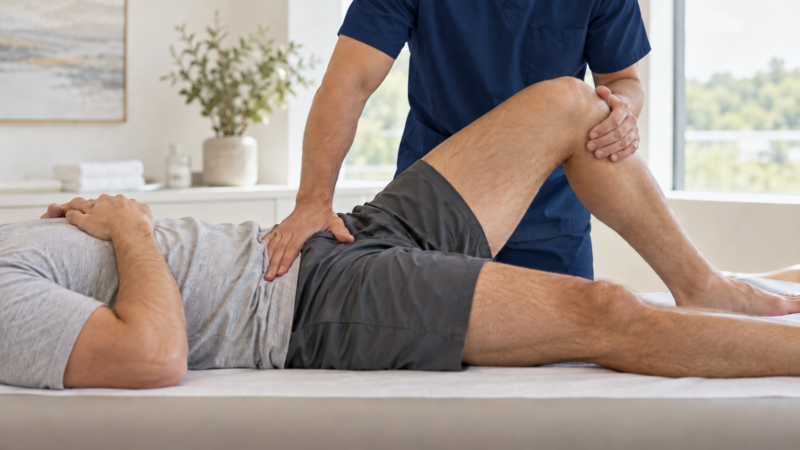
At Pelvis NYC, Dr. Gvili looks for asymmetric or painful hip rotation, particularly in hip flexion. He observes whether symptoms change when the hip is repositioned or unloaded and whether a patient shifts weight, avoids hip extension, or substitutes lower-back and pelvic movement during a squat or step-up.
Single-leg tasks can be particularly informative. “Instead of the hip and glutes controlling the pelvis, the pelvic floor and adductors take over,” Dr. Gvili explains. When this compensation reproduces symptoms, it may suggest that the pelvic floor is reacting to an upstream mechanical problem.
Dr. Gvili also watches for shallow upper-chest breathing and difficulty allowing the pelvic floor to lengthen during inhalation. Together with restricted hip rotation and altered loading, these findings can reveal a broader protective pattern.
Manhattan Pain Medicine evaluates possible joint, nerve, spine, abdominal-wall, and pelvic contributors. Imaging, dynamic ultrasound, or diagnostic blocks may be appropriate. In selected cases, MPM may coordinate a diagnostic nerve block or targeted injection with Dr. Gvili’s assessment, then recheck symptoms or movement while the suspected pathway is temporarily reduced.
Address the Driver, Then Retrain the System
Once a relevant contributor is identified, care can be sequenced around it. Medical treatment may first address hip or pelvic-ring pathology, nerve irritation, or another structural contributor. Depending on the diagnosis, treatment may include targeted injections or, in selected cases, regenerative procedures.
Dr. Gvili’s rehabilitation approach begins with controlled breathing, pelvic-floor coordination, gentle graded hip loading, deep stabilizer activation, and single-leg control. Rather than treating the pelvic floor as an isolated muscle that simply needs stretching, he retrains it to lengthen and relax during functional movement.
Pilates-based work, rotation, and more demanding movement can be introduced as the hip tolerates greater load. As Dr. Gvili puts it, “The goal isn’t just a looser pelvic floor. It’s a hip and pelvis that can share load properly again.”
Men with symptoms that return despite local treatment may benefit from broader evaluation. Sometimes, understanding male pelvic floor dysfunction begins by looking outside the pelvic floor itself.

About Pelvis NYC and Adam Gvili, PT, DPT
Adam Gvili, PT, DPT, is a board-certified physical therapist and owner of Pelvis NYC, a Chelsea, Manhattan practice focused on pelvic health, orthopedic rehabilitation, and movement-related conditions. His approach combines pelvic-floor and whole-body musculoskeletal assessment to identify factors that may be contributing to symptoms and guide individualized rehabilitation.