Frozen Shoulder
Frozen shoulder, also called adhesive capsulitis, is a shoulder condition that causes pain and stiffness as the shoulder capsule becomes inflamed, thickened, and tight. The capsule surrounds the shoulder joint and helps support motion. When it tightens, the shoulder can become difficult to move in several directions.
Patients often notice trouble reaching overhead, reaching behind the back, putting on a coat, washing hair, dressing, lifting, or sleeping comfortably. Some describe a deep ache. Others feel sharp pain when the arm is moved suddenly. As stiffness progresses, the shoulder may feel blocked or frozen rather than simply sore.
How Frozen Shoulder Develops
Frozen shoulder often develops gradually. In many patients, the first stage is painful and may affect sleep. The shoulder may become increasingly stiff over time. Later, pain may become less intense, but motion remains limited. Recovery can be slow. Some patients improve over months, while others take one to three years to regain more normal motion.
Frozen shoulder may occur without a clear injury, but several risk factors can increase the likelihood. These include diabetes, thyroid disease, prolonged immobilization, prior shoulder injury, surgery, stroke, heart disease, and inflammatory conditions. A patient who stops moving the shoulder because of pain may also become more stiff over time.
Frozen Shoulder vs. Other Shoulder Problems
Frozen shoulder is not the only cause of shoulder stiffness. Rotator cuff tears, tendinopathy, bursitis, shoulder arthritis, cervical radiculopathy, inflammatory arthritis, fracture, infection, nerve irritation, and referred neck pain can all create shoulder symptoms. Some patients have more than one problem at the same time.
A key feature of frozen shoulder is loss of both active and passive range of motion. Active motion is how far the patient can move the shoulder. Passive motion is how far the clinician can move the shoulder while the patient relaxes. In adhesive capsulitis, both are often limited. In a rotator cuff problem, the patient may have pain or weakness with active movement, but passive motion may be less restricted.
How MPM Evaluates Frozen Shoulder
MPM begins with a detailed history and shoulder examination. This includes pain location, stiffness pattern, sleep disruption, injury history, prior immobilization, surgery, diabetes or thyroid history, inflammatory symptoms, prior physical therapy, medication response, and any imaging already completed.
The physical examination evaluates range of motion, strength, tenderness, shoulder mechanics, neck referral patterns, and signs that may suggest rotator cuff disease, arthritis, bursitis, nerve irritation, or another soft tissue condition. Diagnostic ultrasound may be used when appropriate to assess shoulder structures or guide injection treatment. MRI or X-ray may be reviewed or coordinated when additional information is needed.
Treatment Options for Frozen Shoulder
Frozen shoulder treatment focuses on reducing pain and preserving or improving motion. Physical therapy and range-of-motion work are often central to care. The therapy plan should match the patient’s stage and pain level. A shoulder that is highly painful may not tolerate aggressive stretching. A shoulder that is less painful but very stiff may need a different approach.
Medication management may help reduce pain or inflammation in selected patients. Anti-inflammatory medications may be considered when appropriate, depending on medical history and risk factors. Steroid injections may be helpful in selected cases, particularly when inflammation and pain are limiting motion or sleep.
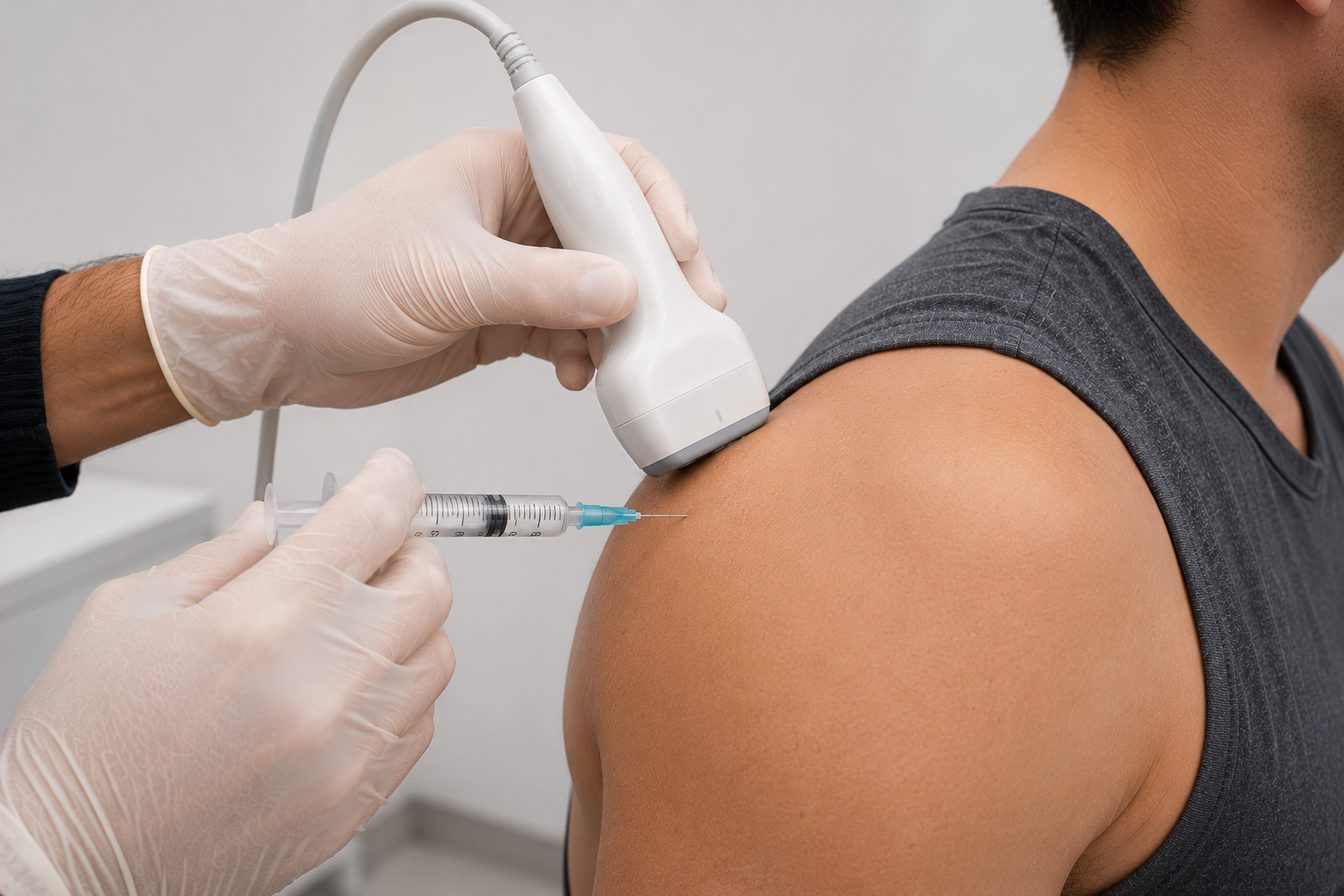
Ultrasound-Guided Steroid Injections
An ultrasound-guided steroid injection may be considered when the clinical picture supports frozen shoulder and pain is limiting function or participation in therapy. Ultrasound guidance allows the clinician to visualize anatomy and improve precision when targeting the joint or surrounding structures.
A steroid injection should not be viewed as a stand-alone cure. It may reduce pain and inflammation, but movement-based care is often still needed to preserve and restore shoulder motion. The best plan usually combines pain control, appropriate stretching, functional movement, and monitoring over time.
Autoimmune and Inflammatory Overlap
Frozen shoulder can overlap with inflammatory or systemic conditions. Some patients with autoimmune-related pain, undifferentiated connective tissue disease, arthritis joint pain, or other inflammatory symptoms may develop shoulder stiffness or pain that needs broader evaluation. In those cases, MPM may coordinate with rheumatology or other specialists when systemic inflammation appears to be part of the picture.
This is important because shoulder stiffness related to capsular tightness is treated differently from shoulder pain caused primarily by inflammatory arthritis, neck referral, nerve irritation, or tendon pathology. Diagnosis-first care helps prevent the wrong treatment pathway.
When Orthopedic Referral May Be Needed
Most frozen shoulder cases are treated without surgery, but orthopedic referral may be appropriate when symptoms are severe, atypical, prolonged, or not improving with appropriate care. Referral may also be needed if imaging suggests structural pathology, if there is significant weakness, or if another shoulder condition is suspected.
How MPM Approaches Frozen Shoulder Care
MPM approaches frozen shoulder through a diagnosis-first, function-focused model. The evaluation considers adhesive capsulitis, rotator cuff disease, shoulder arthritis, tendinopathy, cervical referral, autoimmune-related pain, undifferentiated connective tissue disease, and complex musculoskeletal pain contributors.
For patients looking for frozen shoulder treatment in Manhattan, MPM offers a careful approach to diagnosis, ultrasound-guided care when appropriate, and coordinated treatment planning. The goal is to reduce pain, support shoulder motion, improve daily function, and ensure the care plan matches the true source of stiffness.